Romeo Mesisca
ItalyBorn in 1944
Artist
Romeo Mesisca
ItalyBorn in 1944
Artist
Biography
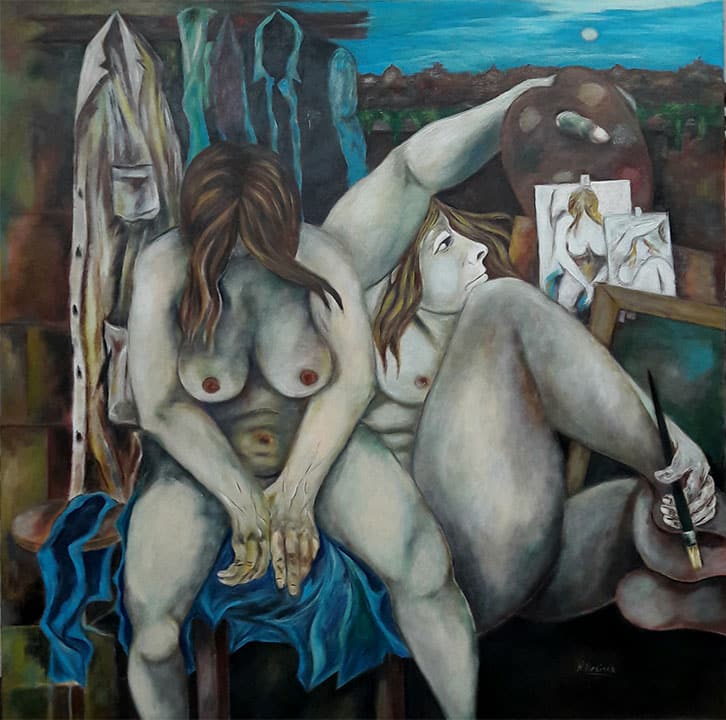
Romeo Mesisca was born in Rome on 14 August 1944. In 1957, during renovation work at his parents' home, at just 13 years old he first became acquainted with painting, copying a self-portrait by Matisse using his father's wallpaper paints as colours and a jute canvas stretched over an improvised wooden frame as a support. In 1965 he began exhibiting, taking part in the artistic events held in spring and autumn on the steps of Trinità dei Monti and in the Galleria Colonna (now Galleria Alberto Sordi), where he came into contact with artists from the famous "Ragazzi di Piazza del Popolo" group, including Mario Schifano, Tano Festa and Giosetta Fioroni, who were very active at the time in the quadrilateral of Piazza di Spagna – Piazza del Popolo – Via Margutta – Piazza Navona.
In 1968, after completing secondary school, during his military service in Mantua he spent over a year visiting the Mantegna Museum, deepening his knowledge of the great painter. In the early 1970s he exhibited several times in the halls of the Galleria Nazionale d'Arte Moderna in Rome, forming his first direct contacts with important figures of the Roman art world. In 1971 he married Rossana Gavazza, with whom he had his only son, Stefano. In 1972 he began working as a teacher, which did not stop him from continuing to paint and exhibit alongside Fiume, Fischer, Attardi, Guttuso, Calabria and Purificato.
In 1973 he held his first solo exhibition at the Galleria d'Arte "Il Pendolo" in Rome and took part in several group shows with Fiume, Pievanini, Isola, Attardi, Calabria and Monachesi. That same year, at the 3rd Biennale di Monterotondo (Rome), he met the writer Leonida Repaci, founder of the "Il Viareggio" literary prize, who awarded him a commemorative plaque for painting. In 1974, for the 1974/1975 edition, the "Ars Dictandi" foundation awarded him the Campidoglio d'Oro of the City of Rome. His association with painters Alberto Sughi and Remo Brindisi strengthened his passion and artistic commitment.
In 1976, through his involvement in the political trade union movement, he met the painter and P.C.I. senator Renato Guttuso, who would go on to have a decisive influence on his artistic future, as well as the art dealer A. Bellisi, owner of galleries in Abidjan (Ivory Coast) and Paris, who offered him a year-long exhibition collaboration. In 1980 he was invited by Diana Gripenberg, granddaughter of the Scandinavian poet Bertel Gripenberg, to join the "Zuleika" artistic movement she had founded. From 1981 he was part of the Radio Giornale group of painters, exhibiting every month in the former Galleria Colonna alongside some of the artists from the "Ragazzi di Piazza del Popolo" group.
From 1982 he was represented by Dario Ruffino, owner of the Galleria d'Arte "La Parametro" on Via Margutta, who marketed his work and presented it at the first television art sales alongside Remo Brindisi, Ezio Farinelli, Bruno Landi, Aldo Pievanini and Lino Tardia. From 1983 to 1988 he built a long-standing collaboration with Rossana Coglitore, owner of the Galleria d'Arte "Derna" in Rome, taking part in numerous exhibitions and solo shows in various Italian cities — Ferrara, Milan, Pesaro, Naples, Rome, Cosenza. In 1988 he was invited by the UIL Confederale to exhibit in the halls of the Stenditoio di San Michele in Rome, in the major group show "Art Against AIDS".
From 1990 he moved to the northern area of Rome (Colli d'Oro), taking over the studio left by the painter Pasquale Monaco and gradually turning it into an "art workshop" open to the public, where he passed on his technical knowledge of drawing and painting; during the same period he took part, by invitation, in the art biennial "The 2nd Sapporo International Print" in Sapporo, Japan. In 1996 the Galleria d'Arte "La Sfinge" in Rome, directed by Mauro Borgiani, organised a solo show for him to mark the publication of his first monograph, published by Bor Art of Rome; around the same time he also met Roberto Giuliani, owner of the Galleria d'Arte "Il Collezionista" in Tarquinia (VT), with whom he would go on to hold a series of exhibitions in Italy and abroad.
In 1997 he was appointed representative of Italian artists on the Lazio Regional Commission for "Legge 200", alongside the art historian Prof. Giuseppe Appella and Prof. Claudio Strinati, superintendent of Cultural Heritage for Lazio. In 2001, at the invitation of the Municipality of Tuscania (VT), he held a solo exhibition in the former Temple of Santa Croce to mark the centenary of the birth of Giuseppe Cesetti, which drew considerable attention from the local and national press.
In 2003 he took part in the Padua art fair with the "Elisir Art Gallery" of Bari; that same year he began a series of exhibitions in Rome, on Via Veneto, at "The Boutique" hotel. Having left the teaching profession, he devoted himself full-time to painting. Between 2005 and 2007 he deepened his relationships with gallery owners and art dealers across Italy; in 2005 he was invited to represent Italy at the 5th edition of the Biennale Internazionale dell'Arte Contemporanea in Florence, on which occasion the catalogue "La realtà interiore" was published, with an introduction by the art critic Prof. Giorgio Falossi.
From 2009 he signed an exclusive one-year contract with the company I-LXY of Bologna, directed by Monica Zanichelli, for the marketing of his work in sixteen countries across the Far East. Between 2010 and 2011 the monograph "Raccontare la vita con il colore" was published by ArteNews and I-LXY of Bologna. In 2012 he was invited by Vittorio Sgarbi to take part in the international initiative "Artisti e Capre" in Pesaro. In 2014 he took part, by invitation, in the 1st Biennale d'Arte of Benevento.
Between 2016 and 2017 he received two years of recognition: the 1st Prize for Painting with Gold Medal at the "Apollo Dionisiaco" Award of the International Academy of Poetic Signification and Contemporary Art of Rome, and an Honorary Degree from the International Academy of the Dioscuri, "for having contributed to the successful dissemination of art culture in Italy and abroad". In 2020 he moved to Ariccia (Rome), with his studio in Genzano di Roma, on the historic street where the Infiorata has been inaugurated every year since 1778.
In 2023 the AccorsiArte gallery of Turin and Venice offered him a permanent collaboration, as did the Arone & Arone gallery of Gerace and Locri (RC). In 2024 he was invited by the Municipality of Apice (BN) to hold a solo exhibition in the halls of the former Town Hall of Apice Vecchio during the Christmas festivities, at the Castello dell'Ettore; in the same period he exhibited with AccorsiArte at the Museo Bellini in Florence, and, at the invitation of the Municipality of Genzano di Roma, painted a work on the theme of the Golden Bough, exhibited at the Museo Sforza Cesarini in Genzano.
Commissioned by the Basilica of Santa Maria degli Angeli in Pietrelcina (BN), he painted a large canvas depicting San Pio with young people, later placed in the Convent of the Capuchin Friars of Sant'Antonio da Padova, in the Santa Lucia district of Apice (BN). In 2025, at the invitation of the Municipality of Genzano di Roma, he exhibited a new painting on the myth of Diana Nemorense at the AccorsiArte gallery in Turin. In 2026 he took part in the "Arte Femmina" group show of resident artists at the AccorsiArte gallery in Turin, and, at the invitation of the Municipality of Genzano di Roma, painted a sketch for the Infiorata dedicated to the 80th anniversary of the Italian Republic, exhibited in the halls of the Museo Sforza Cesarini.
Works
Curriculum Vitae
Appears in
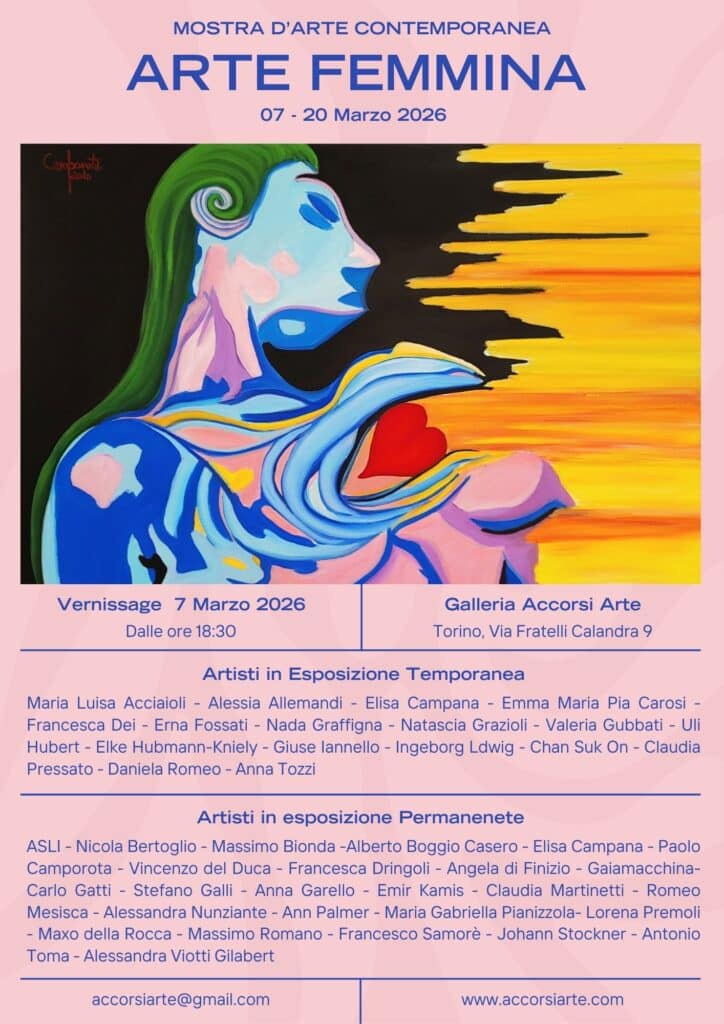
Exhibitions·7 marzo 2026
Arte Femmina - Mostra d'Arte Contemporanea a Torino, marzo 2026
Read the article
Exhibitions·7 ottobre 2023
Mostra Personale di Francesco Burla e Artisti in Permanenza a Torino
Read the article
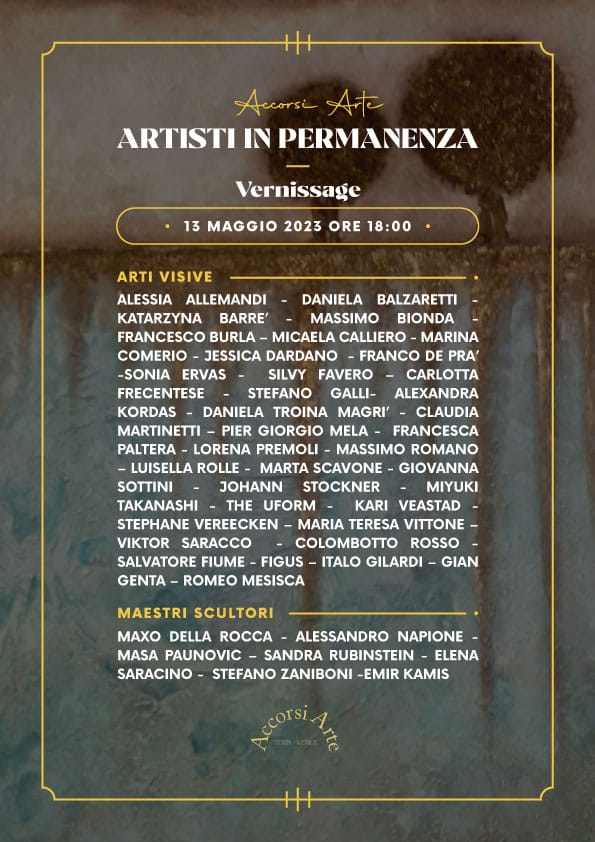
Exhibitions·13 maggio 2023
Vernissage 13 maggio 2023
Read the article
Exhibitions·7 marzo 2026·1 min read
Arte Femmina - Mostra d'Arte Contemporanea a Torino, marzo 2026
Read the article
Exhibitions·7 ottobre 2023·1 min read
Mostra Personale di Francesco Burla e Artisti in Permanenza a Torino
Read the article
Exhibitions·13 maggio 2023·1 min read
Vernissage 13 maggio 2023
Read the article